
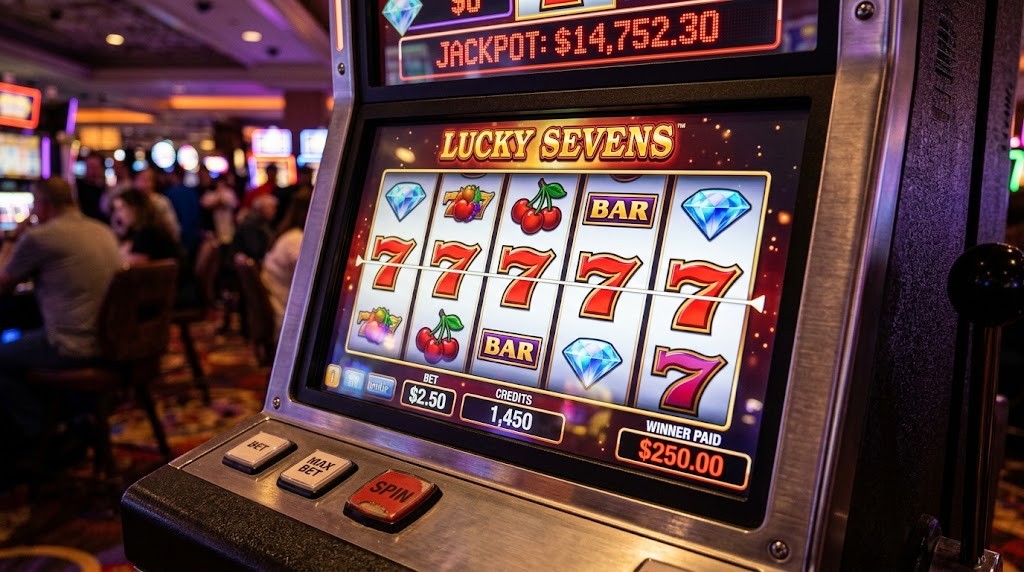
Walk into any modern casino, and the sensory architecture is unmistakable. Chimes ring in synchronized harmony, neon displays cast vibrant gradients across the carpet, and mechanical or digital reels spin in a hypnotic blur. It is easy to look at an idle slot machine—sitting untouched under dim ambient light with its video screen looping a flashy demonstration—and assume it is resting.
In reality, the heart of that machine is operating in a state of unrelenting calculation. Long before a player inserts a bill or touches the glass, the internal microprocessor is churning through complex mathematical sequences at staggering speeds. Slot machine outcomes are governed by continuous Pseudo-Random Number Generators (PRNGs), software algorithms that never pause, never sleep, and never wait for human permission to decide the next outcome. Understanding that these numbers are generated perpetually, rather than manufactured upon command, completely changes how one views the mechanics of the game.
The Relentless Heartbeat of the Algorithm
The fundamental truth of modern gaming technology is that a slot machine does not roll a virtual die when you hit the button. Instead, the machine is rolling those virtual dice millions of times every single minute, twenty-four hours a day, 365 days a year.
At the core of the machine sits a mathematical algorithm designed to produce long sequences of numbers that exhibit absolute statistical randomness. These algorithms begin with a starting numeric value known as a seed. To ensure the seed itself remains unpredictable, modern gaming hardware frequently draws on environmental entropy—microscopic fluctuations in electrical resistance, temperature variations across the processor, or the precise millisecond reading of the internal clock.
From that initial seed, the algorithm executes continuous, cyclical mathematical operations, outputting fresh numbers every few microseconds. Even when a machine sits empty in the corner of a quiet casino at four o’clock on a Tuesday morning, the RNG is cycling through thousands of numerical values every fraction of a second. The process is entirely detached from physical display elements; it does not care about the flashing lights, the sound effects, or whether anyone is present in the room.
The Microsecond Snapshot: What Really Happens When You Press Spin
Because the RNG operates without interruption, the player’s physical input serves a very specific and surprising function. Pressing the “Spin” button or pulling the side lever does not trigger the creation of a random number. Instead, it acts as a microsecond snapshot command.
The exact instant an electrical signal passes from the button into the machine’s logic board, the software reaches into the continuously running stream of numbers and freezes whatever numerical coordinates exist at that specific millisecond.
-
The processor grabs the exact integer values currently on the table.
-
It assigns those raw numbers to specific positions across the reels.
-
It records the final outcome into internal memory and issues instructions to the graphic and audio systems.
Everything that follows that initial tap of the finger—the suspenseful spinning of the reels, the tension-building acceleration of the soundtrack, the near-miss symbols landing just an inch above the payline—is pure theatrical performance. The outcome was mathematically finalized and settled in hardware memory before the physical or digital reels had even completed their first revolution. The spinning animation is simply visual storytelling designed to deliver the result in a manner that human brains find engaging and suspenseful.
Virtual Reel Strips and Numerical Mapping
To translate raw mathematical output into visual symbols like cherries, bars, and scatter icons, slot software relies on a framework known as virtual reel mapping.
In the mechanical era of slots, a game’s odds were physically constrained by the circumference of the physical reel drum, which typically held only twenty or twenty-two physical stops. Modern games, whether video-based or hybrid stepper units, bypass this limitation entirely. The software operates on virtual reels that can contain hundreds or thousands of theoretical stops.
The continuous RNG produces vast numerical values, often spanning numbers from zero into the billions. The software uses mathematical division to map those massive figures down to specific stops on each virtual reel strip. Crucially, these virtual stops are not weighted evenly. A common, low-paying symbol might correspond to fifty separate virtual numbers on a strip, while a rare progressive jackpot icon might correlate with only a single number out of thousands. Because the RNG cycles continuously across this vast probability landscape, every microsecond presents an entirely independent chance to capture one of those rare coordinates.
Debunking the Myth of Cycles and Timing
Understanding the continuous operation of an RNG dismantles virtually every persistent superstition that exists on the casino floor.
The Fallacy of the Machine Being “Due”
Players frequently scrutinize a bank of machines, looking for a title that has not paid a jackpot in hours or days under the misguided belief that the odds are tightening toward an inevitable payout. Because the RNG is generating fresh numbers every microsecond without memory of past results, each individual spin is an independent statistical event.
The algorithm does not keep a ledger of how much money it has collected, nor does it possess an internal mechanism that forces it to balance its payout percentage over twenty spins or two hundred spins. The theoretical Return to Player (RTP) percentage is a long-term mathematical certainty calculated over hundreds of millions of cycles, not a short-term promise. A machine that paid a grand jackpot five seconds ago possesses the exact same mathematical probability of hitting that same jackpot on the very next spin.
The Pain of the Abandoned Seat
A common source of anguish for casino patrons occurs when they abandon a cold machine, only for another guest to sit down immediately and hit a massive payout on their first attempt. The departing player often leaves in frustration, convinced that the other person took “their” jackpot.
In a continuous RNG system, this scenario is a mathematical impossibility. The winning player did not hit the jackpot because the machine was ready to pay; they hit it because they happened to depress the button on the exact, precise microsecond that the RNG’s endless cycle aligned with the jackpot coordinates. Had the original player remained in that seat, the biological variance of their physical reaction time—pausing for a fraction of a second to blink, breathe, or reach for their beverage—would have caused them to press the button at a completely different millisecond, capturing a completely different set of numbers.
The Illusion of the Skill Stop
Many modern machines feature a stop button that allows players to manually halt the spinning reels early. Some believe this feature introduces an element of physical skill, allowing a sharp-eyed player to time the landing of a bonus symbol.
In reality, the stop button alters nothing about the outcome. Because the final numbers were locked into the motherboard the moment the spin sequence was initiated, pressing the stop button simply skips the visual animation and displays the predetermined result immediately. It changes the pace of play, but it leaves the underlying mathematics entirely untouched.
Continuous Testing and Regulatory Integrity
For a slot machine to be legally deployed in a regulated jurisdiction, its continuous RNG must undergo relentless scrutiny by independent accredited testing laboratories. Regulatory bodies require proof that the stream of numbers generated by the processor meets rigorous criteria for non-periodicity and uniform distribution.
Specialized engineers subject the software to millions of continuous automated iterations. They analyze the data using advanced statistical evaluations, ensuring that:
-
No identifiable cyclical patterns exist within the algorithm over billions of cycles.
-
The output cannot be predicted by analyzing previous winning or losing sequences.
-
Outside physical factors, such as electromagnetic interference or static electricity, cannot alter the generation cycle.
Once approved, the compiled binary code is locked with a cryptographic hash. If a single character of code within the RNG is modified on the casino floor, automated compliance systems immediately flag the disparity and disable the machine.
A Pure Exercise in Probability
The visual presentation of a slot machine is engineered for drama, celebrating near-misses and orchestrating celebration sequences that evoke a sense of living momentum. Yet behind that theatrical surface sits a profoundly indifferent instrument of pure mathematics. The random number generator does not care who is playing, how long they have been sitting, or how much capital has entered the validator. It simply executes its calculations without interruption, generating thousands of potential outcomes every second, patiently waiting for the single microsecond when a human touch brings a solitary calculation to light.
